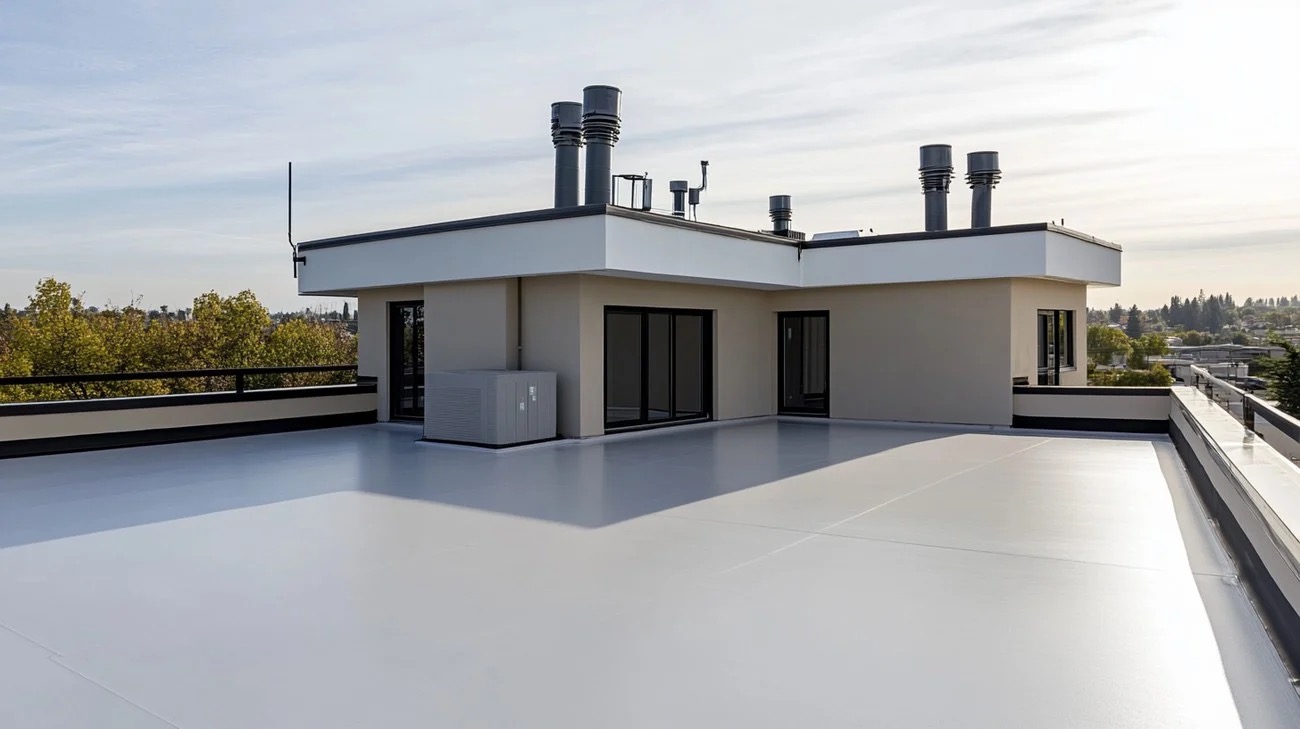
PVC Roof System
PVC Roof System is one of the commercial roof systems Commercial Roofing of New Jersey works with on Newark and North Jersey buildings. No single system is right for every roof, so the point of this page is to be honest about where PVC Roof System fits and where another assembly makes more sense. Here is how we approach it and what the decision usually comes down to.
PVC Roof System earns its place on certain Newark-area roofs and not on others. It comes down to the deck and existing assembly, the slope and drainage, the rooftop traffic and equipment, the budget window, and how long the owner needs the roof to last. We match the system to those realities instead of defaulting to whatever is easiest to install.
A system on a low-slope Newark roof is only as good as the details around it — the curbs, edge metal, penetrations, and how water reaches the drains. PVC Roof System lives or dies at its flashings and terminations, so we scope those right alongside the field membrane.
Most roof systems do not fail in the open field — they fail at the seams, the perimeter, and the penetrations. With PVC Roof System, we hold the line on substrate prep, fastening or adhesion, lap quality, and the terminations at walls, curbs, and drains, because that is where a North Jersey roof gets tested.
On a multi-tenant property near downtown Newark, the roof work has to be planned around people working underneath it. We name interior protection areas, staging limits, and the daily communication that keeps an occupied building running.
A Nor’easter can stall over the New York metro for a day and a half, driving rain sideways into parapets, curbs, and wall terminations. We pay attention to the vertical details and the wind-uplift edges, because those are where a North Jersey roof usually gives up first.
Summer rooftop temperatures on a dark membrane in Essex County climb well past the air temperature, and the daily heating-and-cooling swing fatigues seams and flashings over the years. We plan for thermal movement, not just for the single worst storm.
We factor all of it into the recommendation, because a North Jersey roof that is only planned for fair weather is a roof that gets re-planned the hard way after the next freeze, storm, or ponding season.
The work begins on the roof, not in a brochure. We walk the assembly, talk through the call in front of you — PVC roof system or whatever the roof turns out to need — and turn it into a written recommendation you can actually use.
Most of the buildings we work on around Newark and North Jersey stay occupied while the roof gets handled, so we plan the work around your operations — access, staging, interior protection, and the schedule — and keep you in the loop as it moves. The goal is a roof decision that holds up over time and a property that keeps running while it happens.
Nothing gets priced until the roof condition and the recommendation are on paper. Everything gets written down: the assembly we found, the conditions we photographed, the areas we protected, and the decision we are recommending. That record is what lets an owner approve work with confidence instead of guessing.
Written findings are what let an owner approve work with confidence. For PVC roof system we document the assembly, the conditions, the access constraints, and the recommended option with photographs, so the decision can be defended to ownership, a lender, or an insurer without relying on anyone’s memory of a site visit.